
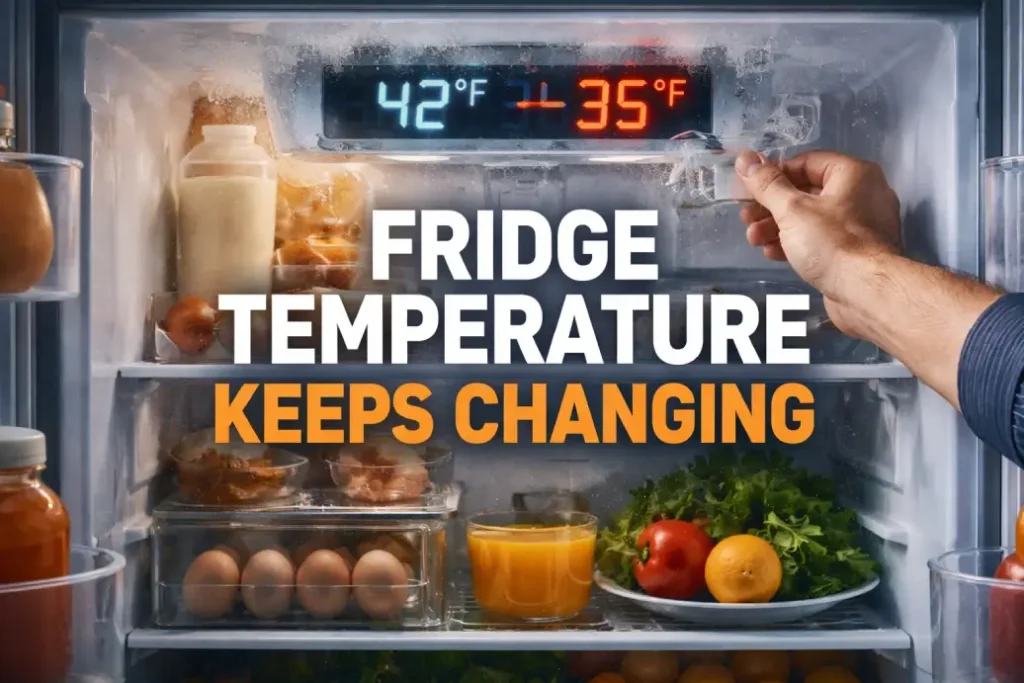
You set your fridge to 4°C (39°F), but the next day the top shelf feels warm and the back wall is almost freezing. If fridge temperature keeps changing, it can spoil food faster, waste electricity, and signal a bigger issue developing.
The good news: many causes are simple and fixable at home. Below is a detailed, practical guide: why it happens, what to check first, what solutions actually work, and when it’s time to call a service tech.
What’s “normal” vs. a real problem?
A refrigerator doesn’t hold a perfectly flat temperature. It cools in cycles: compressor on → cools down → compressor off → slowly warms up. Small swings are normal.
But fridge temperature keeps changing in a problematic way when you notice any of this:
- Milk or meat spoils earlier than expected
- Produce freezes in the crisper while the top shelf stays warm
- Condensation appears and disappears frequently
- The fridge runs for a long time, then stops, then restarts often
- Temperature changes by 3–6°C (5–10°F) or more on the same shelf
- Warranty on repair
- Licensed & Experienced Techs
- Same-Day Fridge Repair
- Open 7 Days a Week
Quick accuracy check (24-hour method)
Put a thermometer in a glass of water and place it on the middle shelf. Water smooths short spikes and shows a more realistic average. If the reading still swings a lot, you’re not imagining it.
Common reasons fridge temperature keeps changing
1) Settings, modes, and “accidental” changes
Some fridges have modes like “Power Cool,” “Eco,” or “Vacation.” After a power outage, settings can reset.
Fix:
- Turn off “Power Cool/Super Cool” unless you’re quickly chilling a large load.
- Set fridge to 3–5°C (37–41°F) and freezer to -18°C (0°F).
- If your model allows it, do a settings reset (check the manual panel instructions).
2) Poor airflow inside the fridge
A fridge cools best when cold air can circulate. If vents are blocked, temperatures become uneven and the sensor reads one zone while food sits in another.
Fix:
- Leave 2–5 cm (1–2 in) gap from the back wall (especially for No Frost).
- Don’t block vents with boxes or large containers.
- Avoid packing shelves “wall-to-wall.”
3) Door seal leaks (gasket issues)
A weak seal lets warm air in, which triggers frequent cooling cycles. That can look like the fridge temperature keeps changing even if the compressor is fine.
Easy test:
Close the door on a sheet of paper. If you can pull it out with almost no resistance, the seal may not be tight.
Fix:
- Clean the gasket with warm soapy water.
- Check for cracks, hardened rubber, or warped corners.
- Ensure the fridge is level so the door closes fully.
- If damaged: replace the gasket (often DIY-friendly, model dependent).

4) Frequent door openings or warm food loads
Every time you open the door, warm humid air enters. Put in a big pot of warm soup and the sensor can swing wildly for hours.
Fix:
- Cool hot food first (to room temp).
- Batch what you need before opening the door repeatedly.
- Don’t keep the door open while “deciding.”
5) Dirty condenser coils or poor ventilation around the fridge
If coils are clogged with dust, the fridge struggles to release heat. That can lead to uneven cooling and erratic cycling.
Fix:
- Unplug the fridge.
- Vacuum the coils (back or underneath) using a brush attachment.
- Ensure proper clearance behind and around the unit (per manual).
6) Defrost system issues (especially in Frost-Free/No Frost models)
A failing defrost heater, timer, or sensor can cause ice buildup on the evaporator. Airflow drops, temperatures bounce around, and some areas freeze while others warm up.
Clues:
- Frost/ice behind the back panel of the freezer
- Fan noise changes or gets louder
- Fridge warms up then suddenly gets very cold again
Possible solution:
- A full manual defrost (unplug 12–24 hours, towels ready) may temporarily help.
- If it returns quickly, it’s likely a defrost component problem → service time.
7) Fan problems (evaporator fan)
In many fridges, the freezer fan pushes cold air into the fridge section. If the fan is weak or intermittent, fridge temperature keeps changing because cold air delivery is inconsistent.
Signs:
- You don’t hear the fan when it should be running
- Fridge section warm but freezer cold
- Temperature differences are extreme shelf-to-shelf
This often requires parts testing/replacement.
8) Thermistor/temperature sensor drift or control board issues
If the sensor misreads temperature, the fridge may overcool or undercool, creating noticeable swings.
Signs:
- Display shows a stable number, but thermometer readings disagree
- Sudden over-freezing in the fridge compartment
- Random behavior after power interruptions
This typically needs diagnosis with the model’s service data.

What to do first: a practical troubleshooting order
- Measure correctly (thermometer in a glass of water, middle shelf, 24 hours).
- Check settings/modes (disable “Power Cool,” reset if needed).
- Improve airflow (don’t block vents, reduce overpacking).
- Inspect door seals (paper test + cleaning).
- Clean condenser coils and confirm ventilation clearance.
- Listen for fan operation (especially when compressor runs).
- If swings persist: suspect defrost system, sensor, or electronics.
Symptoms → likely causes → what you can do
| Symptom | Likely cause | DIY actions | When to call service |
|---|---|---|---|
| Top shelf warm, bottom freezing | Airflow blocked / vent restriction | Rearrange food, clear vents, avoid overpacking | If temps stay uneven after 24 hours |
| Fridge runs a lot, cooling still unstable | Dirty condenser coils / poor ventilation | Clean coils, ensure side/rear clearance, keep room temp reasonable | If compressor becomes very hot, loud, or cooling doesn’t improve |
| Frost buildup behind the freezer back panel | Defrost system problem (heater/sensor/thermostat) | Do a full manual defrost, restart and monitor airflow | If frost returns within 1–2 weeks |
| Door feels “easy” to open, condensation on edges | Weak seal / gasket alignment issue | Clean gasket, check for gaps, level the fridge, warm/reshape minor bends | If gasket is cracked, torn, or warped |
| Freezer OK, fridge warm | Fan issue / damper not opening properly | Check for blocked vents, listen for fan, defrost if airflow is iced up | If fan doesn’t run reliably or damper won’t open |
| Display normal but temperatures swing widely | Sensor/thermistor drift or control issue | Verify temps with a thermometer, reset power (unplug 3–5 min) | If swings continue after reset (often needs diagnosis) |
Ideal temperatures and quick notes
| Area | Recommended temp | Notes |
|---|---|---|
| Fridge compartment | 3–5°C (37–41°F) | Best all-purpose range for food safety and everyday use. |
| Freezer | -18°C (0°F) | Standard setting for safe, long-term frozen storage. |
| Meat/seafood zone (if available) | 0–2°C (32–36°F) | Store items sealed to reduce drying and prevent odor transfer. |
When you should contact a service technician
If fridge temperature keeps changing and you’ve done the basic checks above, call for service if you notice:
- Temperatures rising above 5°C (41°F) for extended periods (food safety risk)
- The freezer can’t hold -18°C (0°F)
- Repeating frost buildup after a manual defrost
- Compressor clicking frequently, buzzing loudly, or failing to start
- Burning smell, visible electrical damage, or tripping breakers
- Water leaking persistently from inside panels (not just a full drip tray)
- Error codes on the display (these often point to sensor/defrost faults)
Tip: When calling service, provide:
- your thermometer readings (water-glass method),
- how often the swings happen,
- whether the freezer stays stable,
- any frost buildup location,
- model number.
It speeds up diagnosis and prevents unnecessary part swaps.
- Warranty on repair
- Licensed & Experienced Techs
- Same-Day Fridge Repair
- Open 7 Days a Week
Simple prevention so fridge temperature doesn’t keep changing again
- Keep vents clear and don’t overpack
- Clean coils every 6–12 months (more often with pets)
- Replace worn gaskets early
- Avoid putting hot food directly inside
- Use a fridge thermometer if you store sensitive foods often